

Optical Power Budget
What Is an Optical Power Budget?
Think of it like a fuel gauge for light. Every fiber link has a finite amount of optical power — the power budget tells you how much you have to spend after accounting for all losses along the way.
If the budget is positive, the link works. If it goes negative, your receiver won’t see enough light — and the link fails.
The formula on this page lets you calculate that budget for any transceiver and fiber run — before anything gets installed.The formula on this page lets you calculate that budget for any transceiver and fiber run — before anything gets installed.
Don’t Use Every Last dB
Always leave margin for real-world losses like dirty connectors, patch panels, fiber bends, repairs, and aging optics.
Rule of thumb: Aim for 3 dB of spare margin after all calculated losses.
If the final budget is close to zero, the link may flap, show errors, or fail later — even if it links up today.
THE FORMULA
Pbudget = PTx − Lconn − Lsplices − Lcable − SRx
Fiber Attenuation by Wavelength
Worked Example: SFP-10G-ZR (1550 nm)
If Pᵇᵘᵈᶟᵉᵗ is negative, increase margin or shorten the span.
Min. Tx Power (from datasheet)
0 dBm
Rx Sensitivity (from datasheet)
-
(−24 dBm)
Raw Power Margin
=
24 dB
Connector Loss (2 × 0.25 dB)
-
0.5 dB
Safety Margin (industry standard)
-
3 dB
Available for Cable
=
20.5 dB
1550 nm fiber attenuation
÷
0.25 dB/km
Maximum Reach
=
82 km
This is why the SFP-10G-ZR is rated at 80 km — manufacturers apply a standard 3 dB safety margin.
Watch the Other End Too
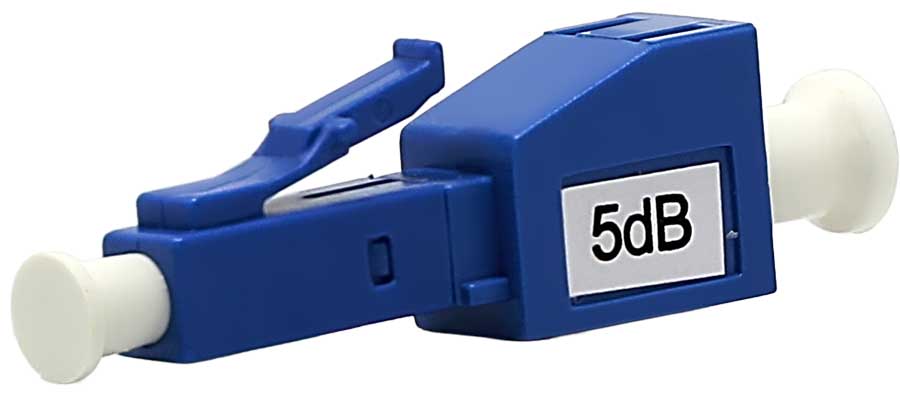
Too close can also be a problem. If received power exceeds the receiver’s maximum, the link can overload and fail.Check Max Tx Power and Max Rx Power from the datasheet. Very short links may need an in-line attenuator.